Monday, October 8, 2018

Columbia, SC Isn't Named After Columbus


Growing up in Columbia, South Carolina, I was always under the impression that my city was named after Christopher Columbus. There's even a statue of Columbus in Riverfront Park with a plaque saying "The first city as well as the first-planned capital in America named after Christopher Columbus..."

 
Christopher Columbus statue in Riverfront Park. Photos courtesy of One Columbia.

The problem is this isn't true.

The word Columbia had been used to describe the thirteen colonies since the 1730's. Yes, the word derived from Columbus but by the 1780's when the city of Columbia was formed, it had taken on a whole new meaning as a concept and the personification of the United States in goddess form.


A depiction of the goddess Columbia

The personification of Columbia was invented by poet Philiss Wheatley, a formerly enslaved woman, in her 1776 poem entitled His Excellency General Washington, of which here is an excerpt:
   Celestial choir! enthron’d in realms of light,
Columbia’s scenes of glorious toils I write.
While freedom’s cause her anxious breast alarms,
She flashes dreadful in refulgent arms.
See mother earth her offspring’s fate bemoan,
And nations gaze at scenes before unknown!
See the bright beams of heaven’s revolving light
Involved in sorrows and the veil of night!

   The Goddess comes, she moves divinely fair,
Olive and laurel binds Her golden hair:
Wherever shines this native of the skies,
Unnumber’d charms and recent graces rise.
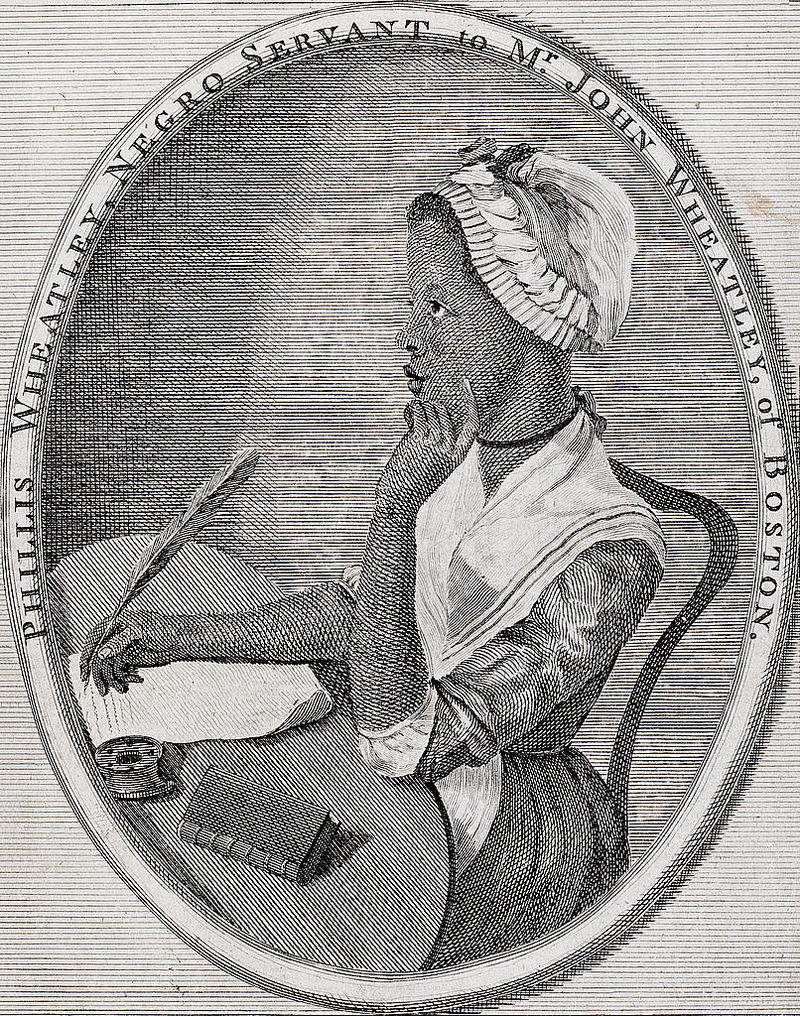
Phillis Wheatley

The Wheatley Branch of Richland Library is named after her and there is picture of her inside.


When it came time to pick a name for the new capital that was being moved from Charleston to its present site, Senator John Lewis Gervais, whom the present day street is named after, in 1786 said, "in this town we should find refuge under the wings of COLUMBIA." It is from this speech that people rallied to name it Columbia, beating out the name Washington in an 11-7 vote in the state senate.

John Lewis Gervais

It is clear from Gervais' quote that Columbia, South Carolina was named for the goddess Columbia and not Christopher Columbus.


The Plants That Ward Off Evil Spirits in Randolph Cemetery


Randolph Cemetery, located next to Elmwood Cemetery, was the first African American internment in Columbia, South Carolina after land was bought for it in 1872. Prior to this, black Columbians were buried with poor whites in the "potters field" nearby. The cemetery is named after Benjamin Franklin Randolph who was an African American senator that was assassinated in 1868 during Reconstruction Columbia.

A fascinating feature of the cemetery are the multitude of cactus and yucca planted both on graves and surrounding them. This is a West African tradition of planting abrasive and thorny plants to ward off evil spirits. The white flowers theses plants produce also coincide with the West African tradition of white meaning death and that the world of the dead was supposed to be white and watery.

The Committee for the Restoration & Beautification of Randolph Cemetery (CRBRC) is meticulously attempting to contact every family member of someone buried here so that they are aware of these and other cultural and spiritual practices in the cemetery that have their roots in West Africa.


Sources:
Historic Randolph Cemetery Cultural Customs
Randolph Cemetery:Mapping and Documentation of a Historic African-American Site

Friday, October 5, 2018

Shapeshifting Daniel Koon of the Dutch Fork

Daniel Koon after transforming himself into the bodiless head of an old man. Art by Patrick Jeffords.

The most famous magician in the Dutch Fork of central South Carolina was Daniel Koon. We spoke of him in our earlier post concerning his prowess in the art of "using" which could miraculously heal the suffering of others. More spectacularly though, he could change shape into a multitude of different objects and beings letting him sit out the Civil War in many ways.

Being born in 1810, Daniel Koon would have been too old to have been drafted by the Confederacy, yet one day Confederate soldiers with bloodhounds began trailing him to force him into service after refusing to enlist saying it went against his principles. Being a wizard, he would have been able to live his life looking much younger than he actually was and may explain both why he was popularly known as Little Daniel and also being targeted for enrollment. He was with a friend at the time the bloodhound was about to catch up to him when Daniel circled his companion and said they must both stand still. The hound began whining and backtracking after seeing that where the two men were was now just a pile of dead pine tree branches.

Later, Union soldiers in the area were looking for him, so to avoid detection he turned himself into a log. With no suspicion, the soldiers sat on the log to rest. He is quoted as saying in later years that "they sat there and ate their food and rested a while, and , Lord, they got heavy! I didn't see how I could stand it much longer, but when one of them took out his knife and began to whittle on me, that just wouldn't do!"

Being bored during the war years, Daniel enjoyed playing practical jokes like the following one on a neighbor's young daughter. She was at a spring collecting water when Koon turned himself into an old man featuring a long gray beard but lacking a body. The head just laying on the ground winked at the girl causing her to run away in terror.

Daniel Koon died in 1876 after a life filled of healing, shapeshifting and even magically putting out forest fires. Luckily his house still exists and can be visited on the Lexington County Museum property. The museum will be opening the Koon residence up to the public at a special Christmas open house later this year.


Source: Bradley, F.W. "Dutch Fork Won't Tell Secret of Little Daniel"The State 15 Jul. 1962

Thursday, October 4, 2018

Old Pictures of Halloween in Columbia

"These hobgoblins and witches in a skull-decorated Model T, were among the hundreds of Halloween celebrants last night who swarmed into the downtown section by automobile." The State, Nov. 1, 1958


"In droves they stampeded head on heels, down the Capital City's neon canyon 'midst shouts, blaaaa's, quieter chi-chi rattles, whistles and exploding firecrackers." The State, Nov. 1, 1958


1956 Halloween party at Carolina Children's Home hosted by the Columbia chapter of B'nai B'rith Girls, a youth led Jewish organization.


"Susan Rentz, playing the role of the "Old Witch," talks flying technique with "Astronaut" John Morris as "The Wolf," Malcolm Rentz, appears on the scene, as part of the city-wide celebration Wednesday of Halloween." The State, Nov. 1, 1962


1954 Jack and Jill Party at Waverly School Auditorium at 1220 Oak Street in Columbia. Per Wikipedia, Jack and Jill of America was formed by African American women with the idea of bringing together children in a social and cultural environment.

From the Richland Library Walker Local and Family History Midlands Memories Digital Collection

"Goblins and gremlins, both wee and woppin' wandered happily 'twixt the State House and the Jefferson Hotel on Columbia's Main Street last night." The State, Nov. 1, 1958


Trick or Treaters in 1962


Corner of Main and Taylor Street on Halloween in 1954


Governor Carroll Campbell (dressed as Hugh Hefner?) before a Halloween Party at the Governor's Mansion

Wednesday, October 3, 2018

The 1987 South Carolina Criminal Justice Academy Manual on Satanism


In 1987, at the height of America's "Satanic Panic", a training manual was produced by Paul Banner, Senior Criminology Instructor, for the South Carolina Criminal Justice Academy which is based in Columbia.

The seminars it was accompanied with were designed to provide officers with an ability to recognize, identify, and investigate criminal activities of Satanic Cults. These one day seminars were offered from July 21, 1987 to at least April 6, 1989 according to notices found in Criminal Justice Chronicle: The Newspaper of The South Carolina Criminal Justice Academy.

Internet searches found that not only was this manual produced but even t-shirts. One of which found its way on Etsy recently:


Here are some examples of the contents of the manual. I have embedded the full manual as a PDF at the bottom of this post.


Tuesday, October 2, 2018

She Lies Beneath Washington Street United Methodist Church


Sophia Catherine Nance before 1996. Photo from Grave Words, Epitaphs of South Carolina by Craig Metts

There are no records of Sophia Catherine Nance ever existing. She is in no census, there are no mentions of her name in newspapers. We know she once lived though because her metal coffin, with a glass oval revealing her face, lies underneath the floorboards of Washington Street United Methodist Church in downtown Columbia, South Carolina.

"The casket resembles an Egyptian mummy's sarcophagus and is shaped like a woman's body, with feet raised, stomach slightly concave and chest curved outward. At one end of the coffin, a small oval metal plate covers a similar glass piece. Through the glass, observers can see the face which once belonged to Sophia Nance." (A Grave with a View by Angshuman Nas, Currents, Spring 1992)


When the church needed to expand in 1928, they sent a call out to family members who had loved ones buried there to move the graves to Elmwood Cemetery. No one answered the call for Sophia so they built over her.

To get to her casket one must first remove the cleaning cart from a broom closet and lift up a rug. This reveals a trap door which if opened leads to a crawlspace 20 inches high.


On hands and knees you must traverse past tombstones, tree stumps and electrical wiring for about 20 yards. Turning a corner at a floor joist and a steel pipe brings you to her casket half-buried in the ground with the top half sticking out. Peering into the glass window one would see that:

"Her dried-out skin has darkened and become like leather, but the pores are clearly visible. Withering eyelids partly cover empty sockets, and brown eyebrows remain on her forehead. Her nose is perfectly shaped, though the skin is taut over the bone. In her mouth are five or six decaying teeth. There are beads of moisture around the neck, and a bit of her clothing is visible under her chin." (A Grave with a View by Angshuman Nas, Currents, Spring 1992)

A tombstone raised 10 inches above the grave has the following inscription:

Sophia Catherine Nance
24th January 1853
aged 28 years 6 months and 14 days

You can't go down there anymore. About 1996 a crack appeared in the glass, possibly from a child tapping it as it was not uncommon for children to go see the woman beneath the floorboards. The remains began to decompose making the skull appear that it was covered by a soft, white foam. The Reverend Mike Alexander considered getting the glass cover fixed but decided to "let nature run its course".

Photo from The State Newspaper, June 6, 2002 showing the white fluffy substance that appeared after the crack


Monday, October 1, 2018

Zauberspruch: Scraps of Old Dutch Fork Healing Magic


The Germans and Swiss who made their way to that part of the interior of South Carolina known as the Dutch Fork (Dutch being an Anglicization of Deutsch) brought with them a type of healing magic called "using" which employed incantations called Zauberspruch. What they practiced was a combination of old world paganism and Christianity. These "users" could only teach their skills to a member of the opposite sex and the rites involved must be kept secret or they would lose all their power.

The most famous of these users was Daniel Koon. The house that he lived in from his birth in 1810 until his death in 1876 can be visited at the Lexington County Museum and I will share his story at a later date.

"He could 'use' to stop the flow of blood, cure warts, heal burns. He could also walk around a forest fire or a field of burning broomsedge, and by repeating a formula, cause the fire to go out. He could change his form, and people saw him sometimes as a stump by the road where no stump had been.

Little Daniel Koon learned how to do all this by reading a book. All over the Fork, people know scraps of what was in it. They even know who wrote the book, but they won't tell you."
(The State Newspaper, July 15, 1962)

Not all are as successful though, one enchanter was trying to extinguish fire but when walking in front of the flames was "cut off from escape from the field, and was forced to run for his life and jump in Lake Murray".

The following "scraps" are taken from James Everett Kibler, Jr.'s book "A Carolina Dutch Fork Calendar". He published in it the following incantations from a using book in his possession written by a twenty-two year old Nancy Catherine Kinard Kibler of the Dutch Fork in 1847. Where you see "ABC" you insert the sufferer's name and where you see "XXX", that signifies that the incantation should be said in specific time intervals. This is explained in Lee Gandee of Lexington's book "Strange Experience, The Autobiography of a Hexenmeister":

"The first is said and the signs are made when the Hex undertakes treatment. The incantation is repeated and the signs are again made a half-hour later; the third repetition and third signs are made an hour after the second, making a total of of nine signs in the course of the treatment."

This art which has its roots in pre-Christian Germany survived, making its way to the Midlands of South Carolina. Is it extinct? Are there no more users? I don't know. It is said to have at least still been practiced by some into the 1970's.

Blood stoppage: 
Blood stand as still as the Water in the sea
ABC god the father, god the son, god the holy ghost
XXX
Grat god horred is the Buren through Christe XXX

for Burn:
Tow (two) angle cam from the north
1 was a fire and the outher
was frost  hear angle take
this fire out of my hand XXX

Colic:
I stand on wood I see wood for
one glass full of could read wine
rising of the Mother or colic   let
this gripping alone. A.B.C. may this helpe
you in the name of the father and in the son
and the name of the holy gost.

Fever:
O you hot burning flame you are so
hot and Dark with God the father
I hunt you with god the son I drive
you [with] God the holy gost
god the father
god the son
god the holy gost

Growfast:
Take the child to any three corners in the house and shake them

Growfast let go from the heart
Allso from the back and ribes as
Our saviour went away from the
Manger. ABC May this help
 you in the name of the father and in the
name of the Son and in the name of
the holy Ghost Amen Amen and Amen
XXX

Greedy worm:

The worm from the child's stomach will be banished to a well where it will be allowed to have its fill.

When the lord and Saviour Jesus Christ
was upon the land then he not a
greedy worm had and he saide
greedy worm wheare are you going
in the childe stumick oh no
you shall not do that  that I forebide
You by sulfer and pitch that I never see
eny more
Do you go in the good water
Theare is a well cool and coald
Out of that well you may drink
And of this childe no more think
in the name of the father and of the son
and in the [name] of the holy goste
amen amen amen

fore the head ache [or "Open Head"]:
I look in god's three gardenes brother
comfort and kind    XXX
head I squeeze you shutt so you
can get your rest   XXX

Misery:
Surely he hath born our grief and carried our sorrows
yet it did esteem him stricken smitten of god and
afflicted. May this help ABC in the name of the
father, son, holy gost.
Start at neck and rub downward

Sun paine:
Grate god hear i stand on woode, i see wod
come and take this paine out of ABC head XXX

Toothache:
As the Lord passed by he saw Peter and said
unto Peter what aileth thee Peter and Peter said
unto him my tooth acheth me and the Lord
said unto Peter believe and though shall be saved